
Appearance
BlueFox Email vs Resend
Resend and BlueFox Email turn up on the same shortlists, but they aren't really built for the same person. Resend is an email API you write code against. BlueFox Email is a control panel you design in. Almost every difference that matters between them, how you build an email, how you pay, how much you touch your own sending infrastructure, comes back to that one split.
So this isn't a contest where one tool sweeps every round. There are things Resend does that BlueFox doesn't try to do, and the reverse is just as true. The useful question is which side of the split you're on. Here's how to tell. Numbers reflect public pricing and documentation as of October 2026.
The short version
If you're a developer shipping a product and you want to build emails the way you build the rest of your app, Resend is hard to beat. React Email, a clean API, eight official SDKs, inbound email, a CLI, and an MCP server make it about the most pleasant email tool to integrate right now. For purely transactional sending it's also the cheaper of the two at low and mid volumes, starting at $20 a month for 50,000 emails. The catch is that the transactional plans cover transactional sending only. Marketing email is a second subscription billed by contacts, and a dedicated IP or a dedicated Slack support channel means moving up to the Scale plan, from $90 a month.
If email is something your team designs rather than codes, if you send marketing alongside your transactional mail and don't want to pay for every stored contact, or if you want sending to run on your own AWS account, BlueFox Email is the better home. Bring-your-own-SES is entirely optional; you can ignore it completely and just use BlueFox's managed infrastructure, but if you do want it, it's there with no extra subscription to add. Either way, every feature (design, automation, marketing, transactional) is included on every plan from day one, and the only thing that ever costs extra is a dedicated IP, which is normal at basically every provider, BlueFox included.
Most teams know which of those they are within a sentence or two. The rest of this page is the reasoning behind the call.
Who is going to build your emails
This is the first fork, and it sorts a lot of people on its own.
Resend's answer is code. With React Email, the open-source library its team maintains, you write emails as React components in JSX, in the same editor, with the same version control and type checking you already use for your app. If your stack is React or Next.js, that's a real productivity win, and there's nothing quite like it elsewhere. You can also send plain HTML or text. Since November 2025, Resend has also had Templates: reusable emails stored in your Resend account that you can build in its visual editor, import from existing HTML or React Email code, or create through the API, with typed variables and fallback values, real-time collaboration, version history, and a publish step, so you send by template ID plus variables instead of shipping HTML from your code. For non-developers, that same no-code editor covers broadcasts and Templates, with Markdown and slash commands, global styles per email (background color, link color, container size), per-component styling, and an AI assistant that can draft common emails such as welcome messages and password resets. What it doesn't offer is a shared library of brand blocks and variables reused across a whole template library, the kind of system that keeps dozens of templates or several brands consistent.
BlueFox Email's answer is a drag-and-drop builder, no HTML required, powered by the Chamaileon SDK. What sets it apart is the design system underneath: you build from reusable blocks (headers, footers, CTA rows) and define brand variables (colors, fonts, logos) and components once, then reuse them everywhere so nothing drifts off-brand. Personalization runs on Handlebars, with loop and conditional elements for dynamic content, and the builder includes a stock photo library, a photo editor, dark mode preview, and the VML fallbacks that keep background images intact in Outlook. For anyone who'd rather bring their own markup, BlueFox also has standalone Raw HTML and Plain Text editors, available for transactional and marketing emails alike.
The honest way to read this: a React team that owns its own email will probably find BlueFox's builder unnecessary, while a design-led team or agency managing many templates or brands will find BlueFox's design system the better fit. Pick the one that matches who actually touches your emails.



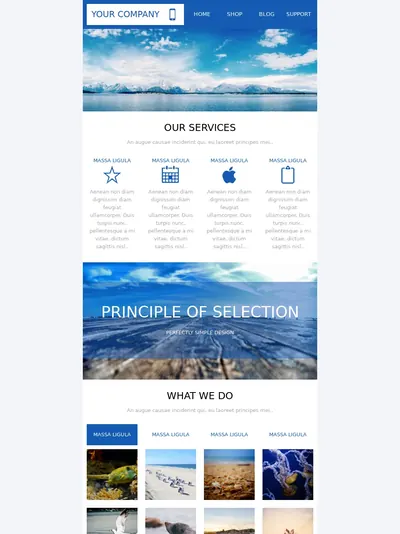

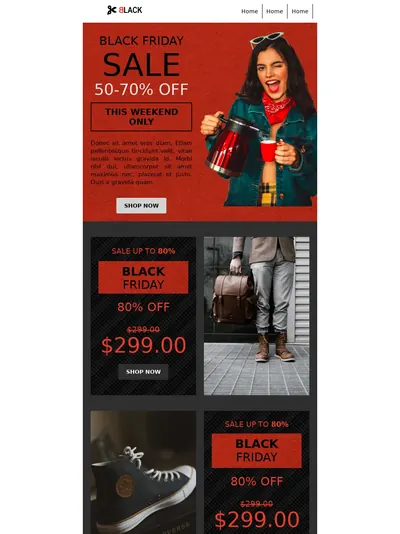




Template 1 of 10: Marketing Agency Newsletter
The pricing models are different enough to change the answer
This is where the two tools stop looking comparable, so it's worth slowing down. The short version: Resend's headline price covers transactional sending, and marketing is a separate, contact-based subscription; a dedicated IP needs the Scale plan. BlueFox's headline price covers everything, and the only thing you'd ever add on top is a dedicated IP.
Resend (two products, two bills)
Resend runs transactional and marketing email as two separately priced products. Transactional email is priced by how many emails you send; marketing email (broadcasts to your contacts) is priced by how many contacts you store, with unlimited sends to them. If you send both kinds of email, you carry both subscriptions. Self-serve plans are billed monthly only, with no annual plans or annual discount.
| Resend transactional | Price | Emails/month | Overage per 1,000 |
|---|---|---|---|
| Free | $0 | 3,000 (100/day) | None |
| Pro | $20 | 50,000 | $0.90 |
| Pro | $35 | 100,000 | $0.90 |
| Scale | $90 | 100,000 | $0.90 |
| Scale | $160 | 200,000 | $0.80 |
| Scale | $350 | 500,000 | $0.70 |
| Scale | $650 | 1,000,000 | $0.65 |
| Scale | $825 | 1,500,000 | $0.52 |
| Scale | $1,150 | 2,500,000 | $0.46 |
| Enterprise | Custom | 3M+ | Custom |
| Resend marketing | Price | Contacts |
|---|---|---|
| Free | $0 | 1,000 |
| Pro marketing | $40 | 5,000 |
| Pro marketing | $80 | 10,000 |
| Pro marketing | $120 | 15,000 |
| Pro marketing | $180 | 25,000 |
| Pro marketing | $250 | 50,000 |
| Pro marketing | $450 | 100,000 |
| Pro marketing | $650 | 150,000 |
What each transactional tier includes: Free has 3 domains, ticket support, and 30-day data retention. Pro removes the daily limit and adds 10 domains and 5 webhook endpoints. Scale adds 1,000 domains, a dedicated Slack channel, 10 webhook endpoints, and the option of a dedicated IP ($30/month, for customers sending more than 3,000 emails a day) and SSO ($150/month) as add-ons. Enterprise adds a 99.99% uptime SLA, guaranteed response times, a dedicated CSM, and flexible data retention. All plans include 10,000 automation runs a month, with paid plans charged $0.0015 per run beyond that.
BlueFox Email (one product, priced per send)
BlueFox Email charges per send, never per contact. One send is one email delivered to one recipient, and transactional, triggered, and campaign emails all cost the same. Contacts are unlimited and free, every plan and pack includes every feature, and sends are bought at the workspace level and shared across all projects. All prices below exclude VAT, which is applied at checkout based on your local rate.
There are two ways to pay (a recurring monthly plan or one-time send packs) and two ways to send: Standard, where BlueFox Email manages the sending infrastructure, or BYO AWS SES, which gives 2× the sends at the same price while you pay AWS directly for sending. New workspaces get a one-time allowance of 3,000 free sends on Standard pricing or 6,000 on BYO SES pricing, valid for 12 months, with no credit card required.
Monthly plans (excl. VAT)
Best for regular, steady sending.
| Plan | Price / month | Standard sends / month | BYO AWS SES sends / month |
|---|---|---|---|
| Starter | $6 | 5,000 | 10,000 |
| Basic | $9 | 10,000 | 20,000 |
| Growth | $19 | 25,000 | 50,000 |
| Pro | $35 | 50,000 | 100,000 |
| Business | $59 | 100,000 | 200,000 |
| Scale | $129 | 250,000 | 500,000 |
| Elite | $239 | 500,000 | 1,000,000 |
Each billing cycle brings a fresh sending allowance, and unused sends do not roll over. You can cancel anytime and keep using your allowance until the current billing period ends, or upgrade anytime by paying the price difference, with the new plan starting right away.
One-time send packs (excl. VAT)
Best for occasional or unpredictable volume, or for teams that prefer to pay upfront.
| Pack | Price | Standard | BYO AWS SES |
|---|---|---|---|
| Essential | $50 | 50,000 sends ($1.00 per 1,000) | 100,000 sends ($0.50 per 1,000) + AWS fees |
| Premium | $300 | 500,000 sends ($0.60 per 1,000) | 1,000,000 sends ($0.30 per 1,000) + AWS fees |
Pack sends are valid for 12 months from the date of purchase, and you're never billed again unless you buy another pack. Packs stack with no cap, and the oldest sends are always used first, so the newest last the longest.
AWS fees (BYO SES only)
In BYO mode, AWS bills you directly for sending, separately from your BlueFox Email plan or pack. At AWS's à la carte rate of $0.10 per 1,000 emails, 100,000 sends add about $10, and every BYO figure in this comparison uses that rate.
If your AWS account is new, check which SES pricing option it's on. Since July 21, 2026, new SES accounts (and account/region combinations with no metered SES activity since June 1, 2025) start on the SES Essentials plan at $0.16 per 1,000 emails for the first 10M per month. You can switch to à la carte pricing at any time.
Dedicated IP
Teams on managed sending can add a dedicated sending IP for $50/month (excl. VAT), at any volume. The IP is reserved for your workspace, so your sender reputation depends only on your own sending. To set one up, email hello@bluefox.email. On BYO AWS SES there's nothing to buy from BlueFox Email: dedicated IPs are set up and billed in your own AWS account.
Custom volume
If you need more than the published plans and packs cover, contact sales at hello@bluefox.email. The team sets up a discovery call to plan your volume and onboarding.
How to read the scenarios
Each scenario below states its own email volume and contact count instead of assuming a typical sending frequency. Resend prices are from its pricing page, using the cheapest tier for each volume (including overage on a lower tier where that works out cheaper). All BlueFox Email prices exclude VAT, and BYO SES figures include AWS fees at $0.10 per 1,000 emails.
Scenarios: monthly plans
Monthly plans suit regular, steady sending, so these scenarios compare Resend's monthly price with the BlueFox Email plan that fits each month's volume.
Pure transactional, 50,000 emails/month:
- Resend Pro: $20/month.
- BlueFox Email Standard: Pro at $35/month (50,000 sends).
- BYO SES: Growth at $19/month (50,000 sends) plus ~$5 AWS = ~$24/month.
Resend is simply cheaper here, and there's no point pretending otherwise.
Pure transactional, 100,000 emails/month:
- Resend Pro: $35/month, with no dedicated IP option.
- BlueFox Email Standard: Business at $59/month (100,000 sends).
- BYO SES: Pro at $35/month (100,000 sends) plus ~$10 AWS = ~$45/month.
Resend still wins on raw price. Add a dedicated IP and the picture changes: at about 3,300 emails a day you clear Resend's 3,000-a-day eligibility threshold, but it needs Scale ($90) plus its $30 add-on, $120/month in total, while BlueFox Email's Business plan plus its $50 dedicated IP is $109/month.
Transactional plus marketing to a small list (50,000 transactional emails plus a weekly newsletter to 5,000 contacts, about 20,000 marketing emails = 70,000 sends/month):
- Resend: Pro transactional ($20) plus Pro marketing at 5,000 contacts ($40) = $60/month, across two subscriptions.
- BlueFox Email Standard: Business at $59/month (100,000 sends).
- BYO SES: Pro at $35/month (100,000 sends) plus ~$7 AWS = ~$42/month.
At this size the managed options are roughly level; BYO SES is cheaper.
Transactional plus marketing to a larger list (50,000 transactional emails plus a weekly newsletter to 25,000 contacts, about 100,000 marketing emails = 150,000 sends/month):
- Resend: Pro transactional ($20) plus Pro marketing at 25,000 contacts ($180) = $200/month.
- BlueFox Email Standard: Scale at $129/month (250,000 sends).
- BYO SES: Business at $59/month (200,000 sends) plus ~$15 AWS = ~$74/month.
This is where the gap opens up: Resend's marketing bill grows with every contact you store, whether or not you email them, while BlueFox Email only counts sends.
High-volume transactional, 500,000 emails/month:
- Resend Scale: $350/month.
- BlueFox Email Standard: Elite at $239/month (500,000 sends).
- BYO SES: Scale at $129/month (500,000 sends) plus ~$50 AWS = ~$179/month.
High volume plus marketing (200,000 transactional emails plus a monthly newsletter to 50,000 contacts = 250,000 sends/month):
- Resend: 200,000 transactional emails on Pro with overage ($35 plus 100,000 × $0.90 per 1,000 = $125, cheaper than Scale's $160) plus Pro marketing at 50,000 contacts ($250) = $375/month.
- BlueFox Email Standard: Scale at $129/month (250,000 sends).
- BYO SES: Scale at $129/month (500,000 sends) plus ~$25 AWS = ~$154/month.
Scenarios: one-time packs
Packs suit occasional or unpredictable sending. BlueFox Email pack sends stay valid for 12 months, so each scenario below looks at a full year. Resend's marketing plans bill every month for the contacts you store, whether you send that month or not.
Occasional campaigns (10,000 contacts × 4 sends a year, such as a quarterly newsletter = 40,000 sends/year):
- Resend Pro marketing at 10,000 contacts kept all year: $80 × 12 = $960/year.
- BlueFox Email Standard: one Essential pack ($50) covers the whole year, with 10,000 sends to spare.
- BYO SES: one Essential pack ($50, 100,000 sends) plus ~$4 AWS = ~$54/year.
A big list, every few months (50,000 contacts × 1 send every 3 months, such as a seasonal announcement = 200,000 sends/year):
- Resend Pro marketing at 50,000 contacts kept all year: $250 × 12 = $3,000/year.
- BlueFox Email Standard: four Essential packs ($200) cover exactly 200,000 sends, bought before each send if you prefer.
- BYO SES: two Essential packs ($100, 200,000 sends) plus ~$20 AWS = ~$120/year.
Cost summary: Resend is the value pick for code-driven, purely transactional sending up to around 100,000 emails a month, as long as you don't need a dedicated IP. Once you want one, BlueFox Email edges ahead. With a small marketing list the two are roughly level on managed sending, but as the list grows BlueFox Email pulls away: about 36% to 63% cheaper at 25,000 contacts and 59% to 66% cheaper in the high-volume-plus-marketing case. At 500,000 transactional emails, BlueFox Email costs roughly 32% to 49% less than Resend Scale, and for occasional senders a pack comes in 93% to 96% below a year of Resend's marketing plan.
Deliverability: both run on Amazon SES, the difference is whose account
It's worth saying plainly: Resend and BlueFox Email are both, ultimately, built on top of Amazon SES. Resend's own domain setup asks you to add an MX record pointing to feedback-smtp.us-east-1.amazonses.com and an SPF record that includes amazonses.com, and BlueFox's managed infrastructure is the same underlying service. Neither company invented a new way to deliver email; both wrapped SES in a friendlier product. So the deliverability basics are close to identical on both sides: SPF, DKIM, and DMARC authentication, automatic suppression of hard bounces and complaints (Resend also lets you manage its suppression list from the dashboard or API), and dedicated IPs available when you want one. Resend's dedicated IP is a $30/month add-on on Scale for customers sending more than 3,000 emails a day, with automatic warmup, monitoring, and autoscaling; BlueFox's is a $50/month add-on for managed sending, requested by email, at any volume and with no tier to reach first. Neither one is meaningfully ahead of the other on raw deliverability tooling.
The real difference is whose AWS account the mail actually runs through. Resend's managed sending, even with a dedicated IP, runs inside Resend's own AWS environment; you never touch the SES console yourself. BlueFox gives you the choice: stay on its managed infrastructure the same way, or switch on bring-your-own-SES and send through your own AWS account, where your reputation is fully isolated and shaped only by your own behavior, your billing is direct with AWS, and you get double the sends on every plan and pack on top of it. That's the genuine differentiator, not the basics, which both platforms handle about as well as each other.
BlueFox's dashboard also shows your live bounce rate against a 2.5% ceiling and complaint rate against a 0.05% ceiling, so you always know where you stand, and every plan includes a subscription preferences page and RFC 8058 one-click unsubscribe.
If you're happy with a managed, hands-off setup, either platform will serve you well, since both are SES underneath. If you want the option to own the AWS account outright, BlueFox is the one that gives you that door.
Automation and the developer surface
For a while the easy thing to say was that Resend had no automation. That's no longer true: it shipped Automations on April 13, 2026, and it's a good addition. You start a flow from a custom event you send from your own app (a signup, an order, a trial ending), then add time delays, wait-for-event steps, and conditions that branch on contact or event data, either in a visual builder or by describing the flow and letting AI assemble it. Everything can also be built and inspected through the API, SDKs, CLI, or MCP server, and every plan includes 10,000 automation runs a month. The thing to understand is that it's event-driven and developer-oriented: triggers come from events your code sends rather than from segments, and connecting tools like Stripe means building that bridge yourself.
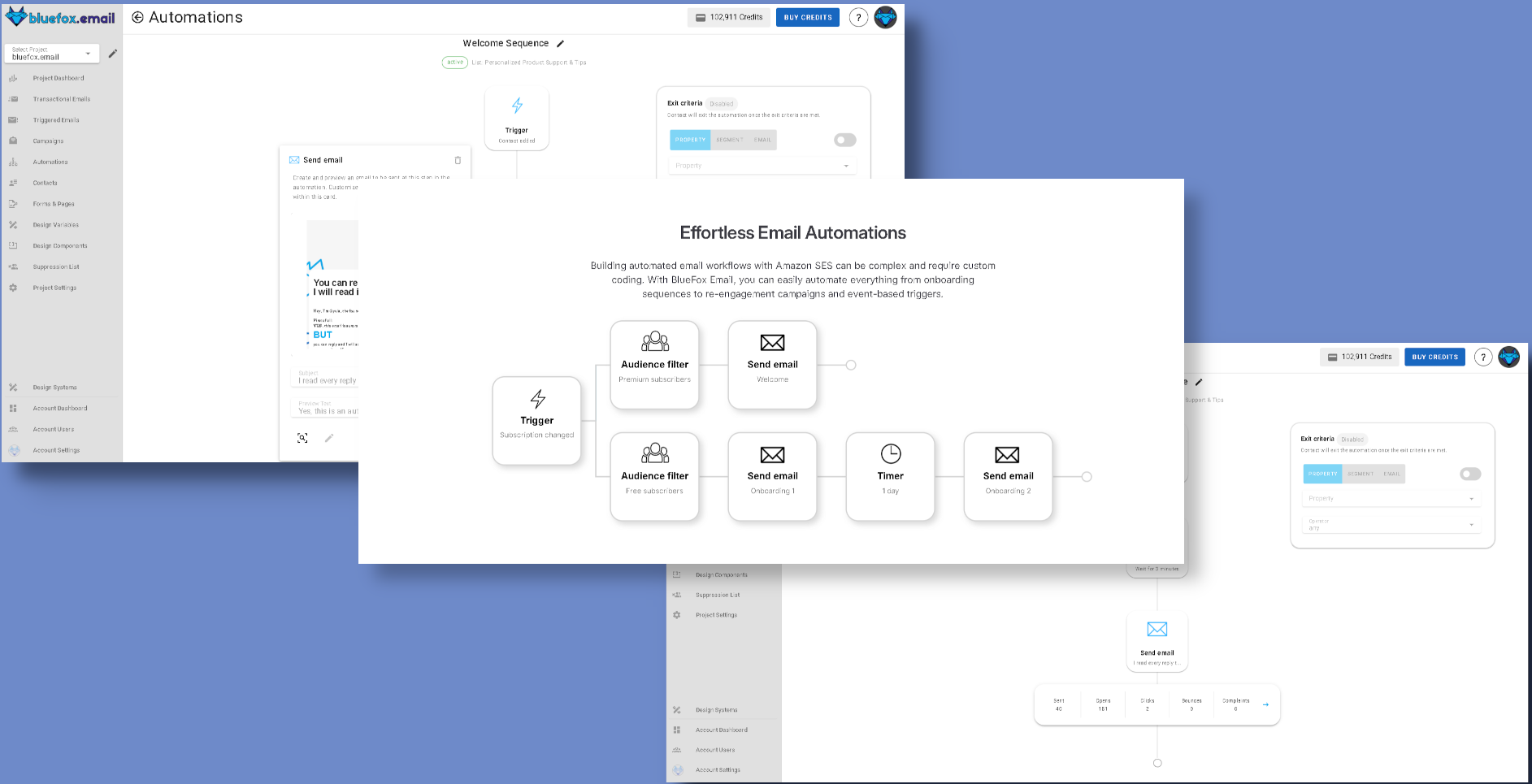
BlueFox's automation builder is aimed at the marketing side of the same idea. It triggers on contact and segment activity (contact added or updated, entering or leaving a segment, recurring time-based schedules) rather than raw app events, and it carries a wider node set: send, timer, audience filter, branching with conditions, plus notify, set-value, manage-tags, and webhook nodes. Its most distinctive trick is that you can edit a running automation and choose whether the change applies to new contacts only or to everyone mid-flow, so you're not rebuilding a sequence to tweak it. Everything is on every plan.
On the broader integration surface, Resend is plainly ahead, and that's by design. Eight official SDKs (Node.js, PHP, Python, Ruby, Go, Rust, Java, and .NET), a REST API, SMTP relay, batch sending, inbound email, multi-region sending, a CLI, a complete webhook event set, and an MCP server for AI agents, with SOC 2 Type II and GDPR compliance on every plan. BlueFox's surface is narrower on purpose: an API for contacts, list management, and transactional and triggered sends, the full webhook set on every plan, a Zapier connector, a Supabase auth path over SMTP, an open-source, local MCP server for AI agents, and the bring-your-own-SES connection. If your integration wishlist is long and code-heavy, Resend will feel roomier.
Reporting
Neither tool is a deep analytics product, and both are honest about that. Resend gives you a dashboard for delivery, opens, clicks, bounces, and failures, searchable email logs, and broadcast reporting, with everything also available over webhooks. The one limit worth flagging is retention: data is kept 30 days on Free, Pro, and Scale, with flexible retention only on Enterprise, so investigating an email someone reports a month later means you've stored the events yourself.
BlueFox slices its numbers by account, project, campaign, transactional email, triggered email, and list, tracks the full set (sends, opens and unique opens, clicks and unique clicks, bounces, complaints, unsubscribes, resubscriptions, pauses), and shows live bounce and complaint ratios against the production thresholds plus per-automation-node breakdowns, with contact-level data exportable as CSV. As with Resend, there's no revenue attribution, benchmarking, or built-in A/B reporting.
Analytics
Analytics that show what happened
Delivery, opens, clicks, bounces, and subscription trends. Switch between hourly, daily, weekly, and monthly views.
Sent6,200
Failed0
Opens4,805
Unique Opens3,210
Clicks748
Unique Clicks182
Bounced8
Complaints0
Support, and who you're betting on
Resend's documentation is one of the best things about it, and the team has a strong reputation for knowing email and answering well. Just know that the level of support scales with the plan: Free and Pro are ticket-based, Scale adds a dedicated Slack channel, and guaranteed response times, a dedicated CSM, and an uptime SLA are Enterprise features.
BlueFox is a small, founder-led company, so support means talking to the people who build the product, and that's true on every plan rather than only the expensive ones. Founder Gyula Németh has worked in HTML email since 2013 and previously built edmdesigner.com, chamaileon.io, and emailhero.io. The flip side of being smaller is a thinner knowledge base and fewer third-party tutorials and community threads than Resend has accumulated.
So, which one
It comes down to the split we started with. If your email is code, mostly transactional, and you want the smoothest possible developer experience at the lowest entry price, Resend is the obvious pick, and it's a genuinely excellent product at that job; just budget for a second subscription once you add marketing, or the jump to Scale if you need a dedicated IP. The moment your email becomes something a team designs, or you're sending marketing next to your transactional mail and don't want to pay per contact, or you want a dedicated IP without changing tiers or to run sending on your own AWS account, BlueFox Email fits the way you actually work, with no surprise extras beyond that same dedicated IP option every provider charges for.
Neither one is the "better email tool" in the abstract. They're built for different people. Figure out which person you are, and the choice mostly makes itself.
Comparing other options? See how BlueFox Email stacks up against SendGrid, MailerSend, and Loops.
No per-contact fees. No second subscription.
Use BlueFox Email's managed infrastructure, or connect your own AWS SES account through the same API. No per-contact billing, no second subscription for marketing.